The corporate landscape across the Front Range is embracing artificial intelligence at a record pace. From innovative tech startups in Boulder and corporate headquarters in Denver to growing industrial and commercial enterprises in Fort Collins and Loveland, local businesses are leveraging AI tools to automate workflows, analyze customer data, and generate content.
However, this rapid adoption has introduced a major cybersecurity blind spot: Shadow AI.
Shadow AI occurs when employees use unsanctioned, public AI applications (such as free web-based LLMs or consumer translation tools) for work tasks without the knowledge, oversight, or authorization of the company’s IT department. While team members usually mean well and are simply trying to work faster, uploading proprietary company data, client spreadsheets, or code into public AI models exposes your business to massive data leaks and compliance breaches.
For business owners and executive teams across Colorado, managing the risks of artificial intelligence requires balancing innovation with strict data governance.
The Hidden Threat: How Shadow AI Exposes Front Range Companies
When an employee pastes text or uploads a file into a free, consumer-grade AI tool, that data is frequently ingested by the platform to train future public models. Once proprietary information enters a public model’s training dataset, it can potentially be retrieved by outside parties through targeted prompting.
Across Denver, Boulder, Fort Collins, and Loveland, professional practices and SMBs are encountering critical vulnerabilities through everyday employee habits:
- Financial Data Exposure: An accountant in Denver pastes a client’s unreleased Q3 financial statement into a free AI tool to draft an executive summary.
- Intellectual Property Leaks: A software developer in Boulder feeds proprietary source code into a public AI assistant to debug an error, inadvertently exposing patentable code.
- Legal & PII Exposure: A paralegal or HR manager in Fort Collins uploads an employee dispute file containing Social Security numbers and personnel records to quickly summarize the case.
Key Risks of Unregulated AI Usage for Local Businesses
1. Regulatory Penalties under the Colorado Privacy Act (CPA)
Colorado maintains some of the nation’s strictest consumer privacy regulations. The Colorado Privacy Act (CPA) mandates that businesses protect personally identifiable information (PII) belonging to state residents. Allowing employees to feed sensitive customer or patient data into unauthorized third-party AI platforms can constitute an immediate compliance failure, exposing your company to statutory fines and civil enforcement.
2. Loss of Trade Secrets and Client Privilege
Unlike enterprise-grade AI deployments, standard consumer AI platforms reserve the right to retain user inputs. If your staff uses free AI engines to draft proposals or analyze contract terms, your firm may inadvertently waive trade secret protections or compromise attorney-client privilege.
3. Cyber Insurance Policy Invalidation
Cyber insurance underwriters now explicitly evaluate how companies handle emerging digital risks. If a data breach occurs because proprietary data was leaked through an unvetted third-party cloud service, your insurer may deny the claim due to a lack of reasonable administrative and technical controls.
Public AI vs. Secured Enterprise AI: What Business Owners Must Know
To protect company assets while allowing teams to stay productive, Colorado executives must understand the structural differences between consumer AI and secured enterprise deployments.
Feature | Consumer / Free AI Tools | Secured Enterprise AI (e.g., Copilot for M365) |
Data Retention | Inputs are stored and used to train public models. | Data is isolated; inputs are never used to train public models. |
Access Control | Anyone with a personal login can paste company data. | Enforced via corporate Single Sign-On (SSO) and Multi-Factor Authentication (MFA). |
Audit Logging | Zero visibility for IT management or security teams. | Full administrative logging of user queries and file access. |
Compliance Alignment | Violates HIPAA, FTC Safeguards, and Colorado Privacy Act. | Aligns with enterprise compliance standards and data residency rules. |
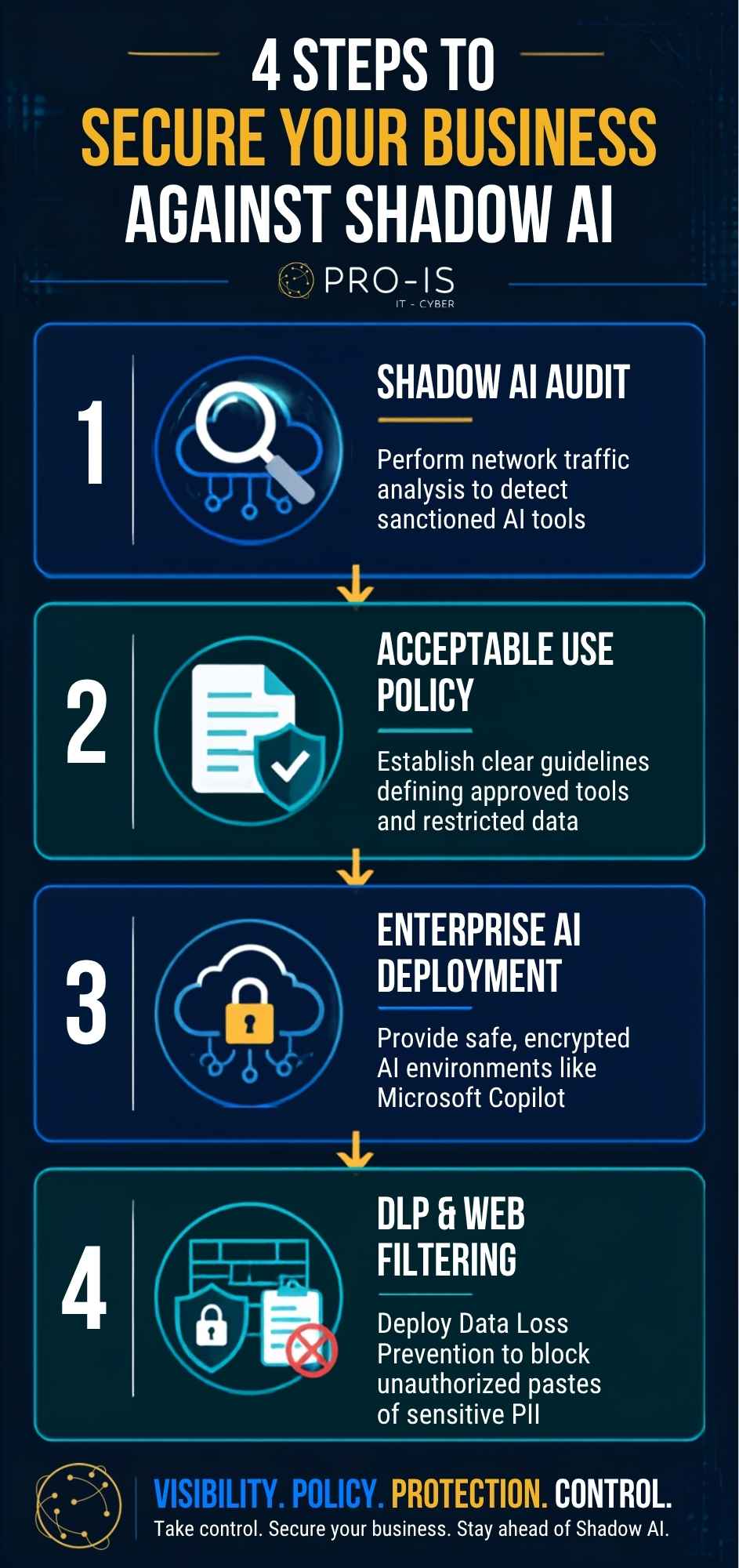
4 Steps to Build an AI Governance Framework
Securing your business against Shadow AI does not mean banning artificial intelligence entirely—prohibitions rarely work and often drive employees further under the radar. Instead, forward-thinking business leaders in Fort Collins, Boulder, Denver, and Loveland are implementing structured AI governance frameworks.
Step 1: Conduct a Comprehensive Shadow AI Audit
You cannot secure what you cannot see. Partnering with a managed IT provider allows you to perform deep packet inspection and network traffic analysis to identify which unsanctioned AI platforms are currently receiving connections from your office workstations and remote laptops.
Step 2: Establish a Clear Acceptable Use Policy (AUP)
Draft a concise, mandatory AI policy for all staff members. The policy should clearly define:
- Which AI tools are explicitly approved for business operations.
- What categories of data (e.g., PII, financial statements, source code) are strictly prohibited from entering any external tool.
- The formal process for requesting security reviews of new software applications.
Step 3: Deploy Enterprise-Grade AI Environments
Give your staff safe, approved alternatives. Deploying enterprise solutions like Microsoft Copilot for M365 or dedicated private cloud AI instances ensures your team gains productivity boosts while keeping all data safely contained within your organization’s encrypted tenant boundary.
Step 4: Implement Endpoint Web Filtering and DLP
Utilize Data Loss Prevention (DLP) and web-filtering software managed by your IT provider. These systems automatically detect and block attempts to paste credit card numbers, Social Security details, or confidential files into unauthorized web browsers and AI portals.
How Pro-IS Secures Front Range Businesses
Navigating emerging technology risks requires an IT partner who understands the local business environment. Pro-IS delivers proactive managed IT support, cybersecurity, and cloud governance tailored to mid-sized businesses, legal practices, healthcare providers, and commercial enterprises across Northern Colorado and the Denver metro region.
Our specialized AI and Data Governance Framework provides:
- Real-Time Network & Endpoint Monitoring: 24/7 detection of unauthorized software and web application usage across your entire fleet of laptops and desktop servers.
- Enterprise Microsoft 365 Architecture: Expert configuration of data loss prevention (DLP) policies, conditional access controls, and secure Copilot environments.
- Local, Business-First Support: Dedicated IT specialists located right here in Northern Colorado who understand your industry’s specific compliance burdens.
Whether your team is located in Denver’s commercial center, Boulder’s tech corridor, or growing business parks in Fort Collins and Loveland, Pro-IS ensures your technology remains a competitive advantage rather than a security liability.
Take control of your data security and protect your proprietary information. Contact the local team at Pro-IS today at (970) 613-0980 to schedule a comprehensive technology and security assessment.