cyber-Security-for-law-firms

Cyber Security & Data Protection for Colorado Law Firms & Financial Practices

The professional services sector across the Colorado Front Range is undergoing a massive operational transformation. From established law practices in Boulder and fast-growing accounting firms in Fort Collins to real estate agencies and wealth management groups in Loveland and Greeley, data has become the primary asset. Every day, these firms handle exceptionally sensitive information: corporate merger details, private tax records, proprietary business strategies, litigation discovery files, and millions of dollars in escrow accounts and wire transfers.

This high concentration of wealth and confidential data has not gone unnoticed. In today’s digital landscape, professional service firms are no longer secondary targets; they are the frontline focus for sophisticated global cybercriminal syndicates. Hackers understand that while a massive bank might spend millions annually on internal security grids, a regional law firm or local CPA practice often relies on outdated, reactive IT support.

For managing partners and firm owners in Northern Colorado, safeguarding client confidentiality is no longer just an ethical obligation mandated by state bars or financial regulatory boards. It is a critical requirement for business survival. As digital threats grow more targeted and sophisticated, securing your infrastructure demands a shift away from traditional, generic IT maintenance toward an advanced, proactive cybersecurity framework.

The Cyber Insurance Dilemma: Moving from Promises to Proof

For years, many professional service firms treated cyber insurance as a catch-all safety net. The prevailing mindset was simple: if a breach occurred, insurance would cover the financial fallout, data recovery costs, and legal liabilities. However, the cyber insurance landscape has dramatically shifted.

Because the frequency and financial severity of ransomware attacks have skyrocketed, insurance underwriters have completely rewritten the rules. They are no longer handing out policies based on a simple, unchecked questionnaire. Today, obtaining or renewing a cyber insurance policy in Colorado requires strict, verifiable proof of an enterprise-grade security posture.

If your network lacks specific, multi-layered technical controls, your firm faces two imminent risks: either your premium will skyrocket to an unsustainable rate, or you will be denied coverage entirely, leaving your business exposed to catastrophic liability.

The Mandatory Technical Controls for Policy Approval

To pass a modern cyber insurance audit, local firms must demonstrate the active deployment of several core defensive mechanisms:

  • Managed Endpoint Detection and Response (EDR): Traditional signature-based antivirus software is entirely obsolete against modern, zero-day malware. EDR solutions continuously monitor all network endpoints (laptops, desktops, servers) using behavioral analysis to detect, isolate, and neutralize anomalous threats in real time.
  • Multi-Factor Authentication (MFA) Everywhere: Insurers now demand that MFA be enforced across every single digital gateway. This includes your corporate email, remote desktop connections, cloud storage repositories, and internal line-of-business software.
  • Immutable Backups with Air-Gapping: If ransomware manages to infiltrate your network, the first thing it will attempt to do is find and delete your digital backups. Insurance companies now require immutable backups—data that cannot be modified, deleted, or encrypted once written—combined with off-site or cloud-based air-gapping to guarantee data restoration.

The Threat of Wire Fraud and Business Email Compromise (BEC)

While ransomware makes the biggest headlines, Business Email Compromise (BEC) remains the most financially devastating threat to local professional service firms, particularly those handling real estate transactions, estate planning, and corporate finances.

BEC attacks do not rely on complex software exploits. Instead, they exploit human psychology and organizational trust through sophisticated social engineering.

The Anatomy of a Targeted Email Interception

A typical BEC attack targeting a Northern Colorado professional practice unfolds in silent, methodical stages:
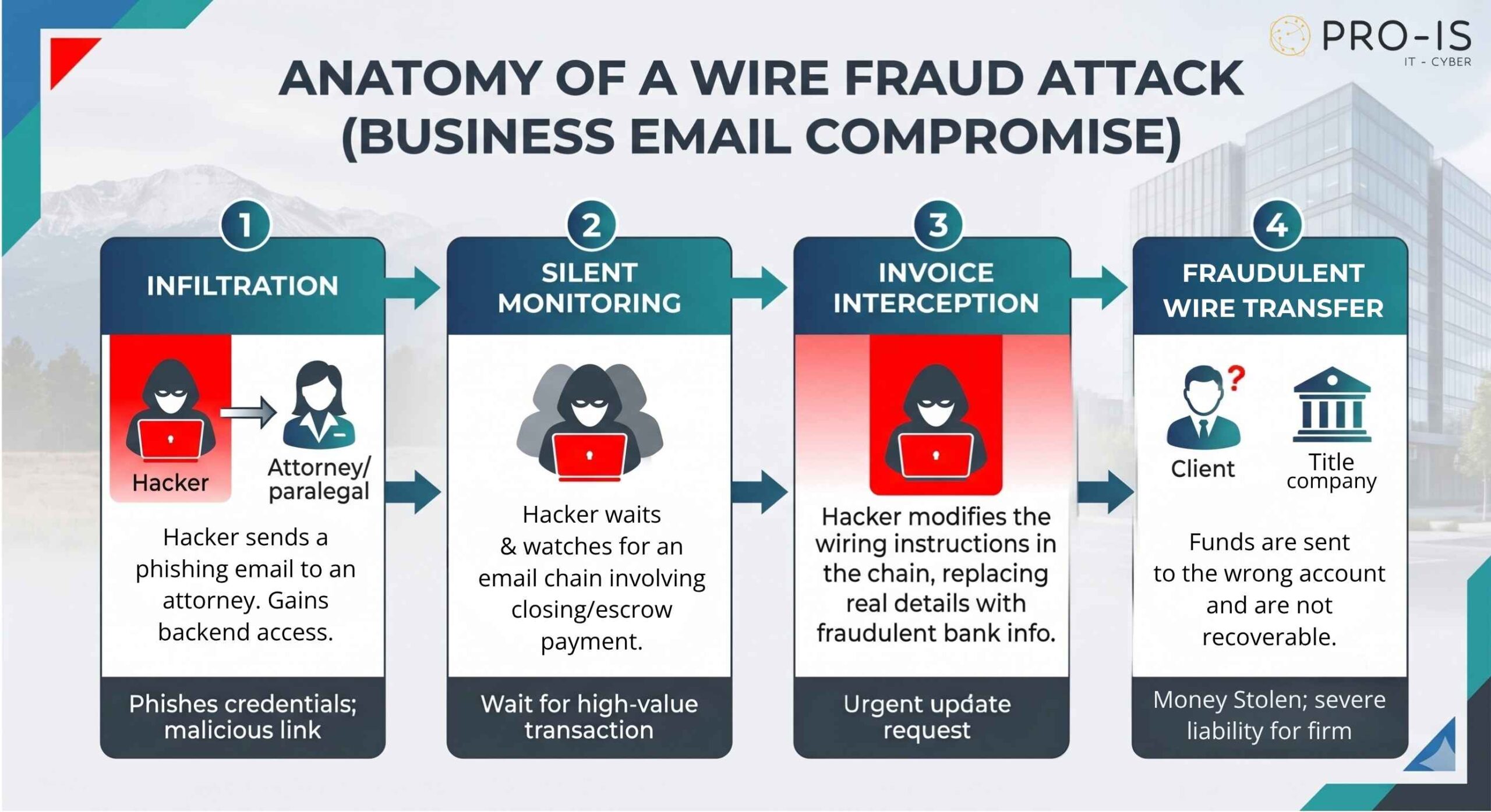
  1. The Infiltration: A cybercriminal successfully phishes the credentials of an attorney, paralegal, or accountant, gaining unauthorized access to their Microsoft 365 or Google Workspace account.
  2. The Silent Reconnaissance: Instead of immediately locking the account or stealing data, the hacker logs in silently. They set up hidden email forwarding rules and monitor ongoing conversations for weeks, waiting for high-value financial transactions, real estate closings, or vendor payments to approach.
  3. The Interception: Once a large wire transfer or escrow payment is scheduled, the attacker intervenes. Sending an email directly from the compromised account—or using a perfectly spoofed lookalike domain—they contact the client or title company with an “urgent update” to the wiring instructions, diverting the funds to a fraudulent account.
  4. The Aftermath: By the time the firm and the client realize the money never arrived at its intended destination, the funds have been laundered through cryptocurrency or international banks, leaving the local practice facing severe reputational damage and intense legal liability.

Preventing these sophisticated attacks requires a combination of enterprise email authentication protocols (such as DMARC, DKIM, and SPF), advanced artificial intelligence tools that scan emails for linguistic anomalies, and strict internal dual-authorization policies for all external financial transactions.

Regulatory Compliance: The Expanding Legal Mandate

Navigating the regulatory landscape has become increasingly complex for independent professional practices across the Front Range. Federal and state agencies are continuously expanding data privacy mandates, holding business owners directly accountable for network security failures.

The FTC Safeguards Rule and Non-Banking Financial Entities

Many local CPAs, tax preparation firms, real estate appraisers, and wealth managers mistakenly assume that federal financial security rules only apply to large Wall Street banks. In reality, the Federal Trade Commission (FTC) Safeguards Rule explicitly covers any institution significantly engaged in financial activities.

Under this mandate, local financial professionals must maintain a comprehensive, written information security program. Failure to implement continuous network monitoring, regular vulnerability assessments, and formal risk assessments can result in severe federal penalties, independent of whether a data breach actually occurs.

The Colorado Privacy Act (CPA)

At the state level, the Colorado Privacy Act enforces strict guidelines regarding how businesses collect, store, and process the personally identifiable information (PII) of Colorado residents. Law firms holding sensitive client discovery data, medical records for personal injury cases, or corporate employee records must ensure their digital environments align with these stringent state-level privacy guidelines.

The Pro-IS Shield: Tailored Managed IT for Professional Services

Many independent law practices and financial groups rely on a reactive, “break-fix” IT support model. They call a computer repair technician only when a server crashes or an employee’s laptop stops working. In an era dominated by automated cyber threats, ransomware-as-a-service, and strict compliance laws, this reactive approach is a direct threat to your operational continuity.

Pro-IS delivers a business-first, highly proactive approach to managed IT support and cybersecurity designed specifically for the unique operational workflows of professional service firms across Boulder, Fort Collins, Loveland, and Greeley.

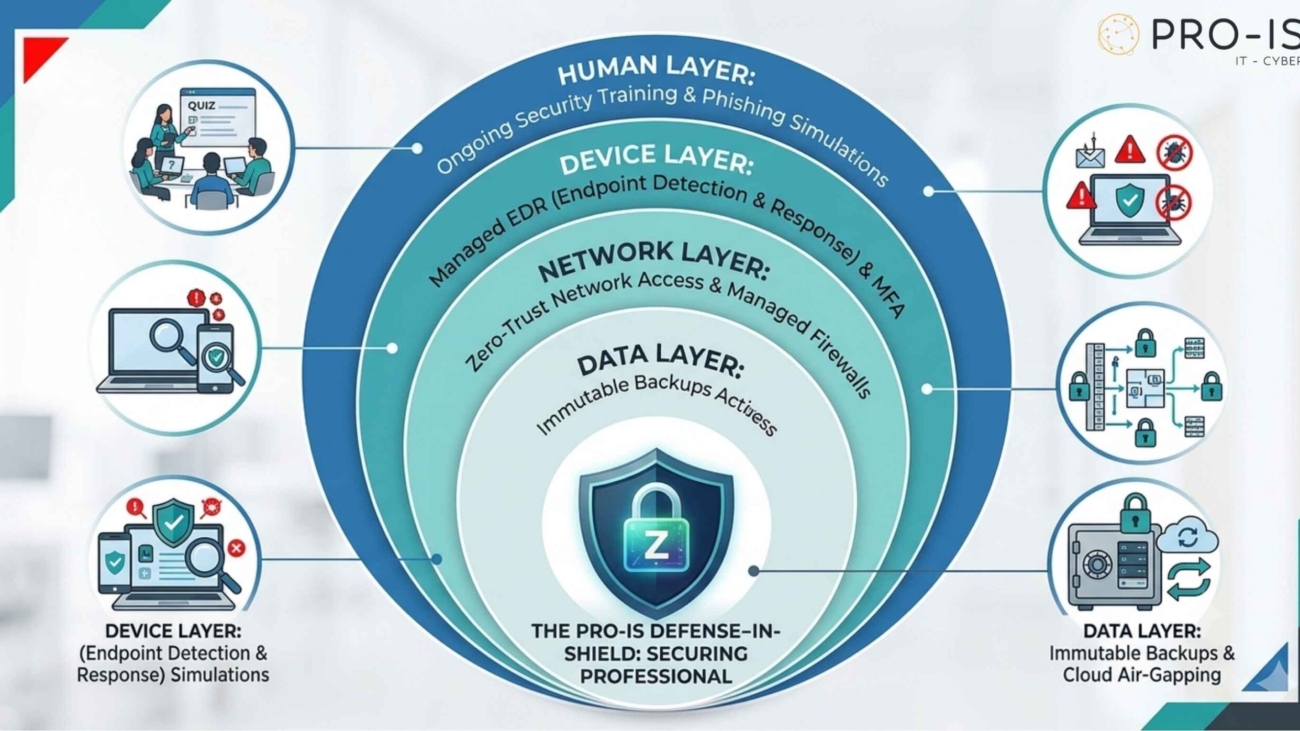
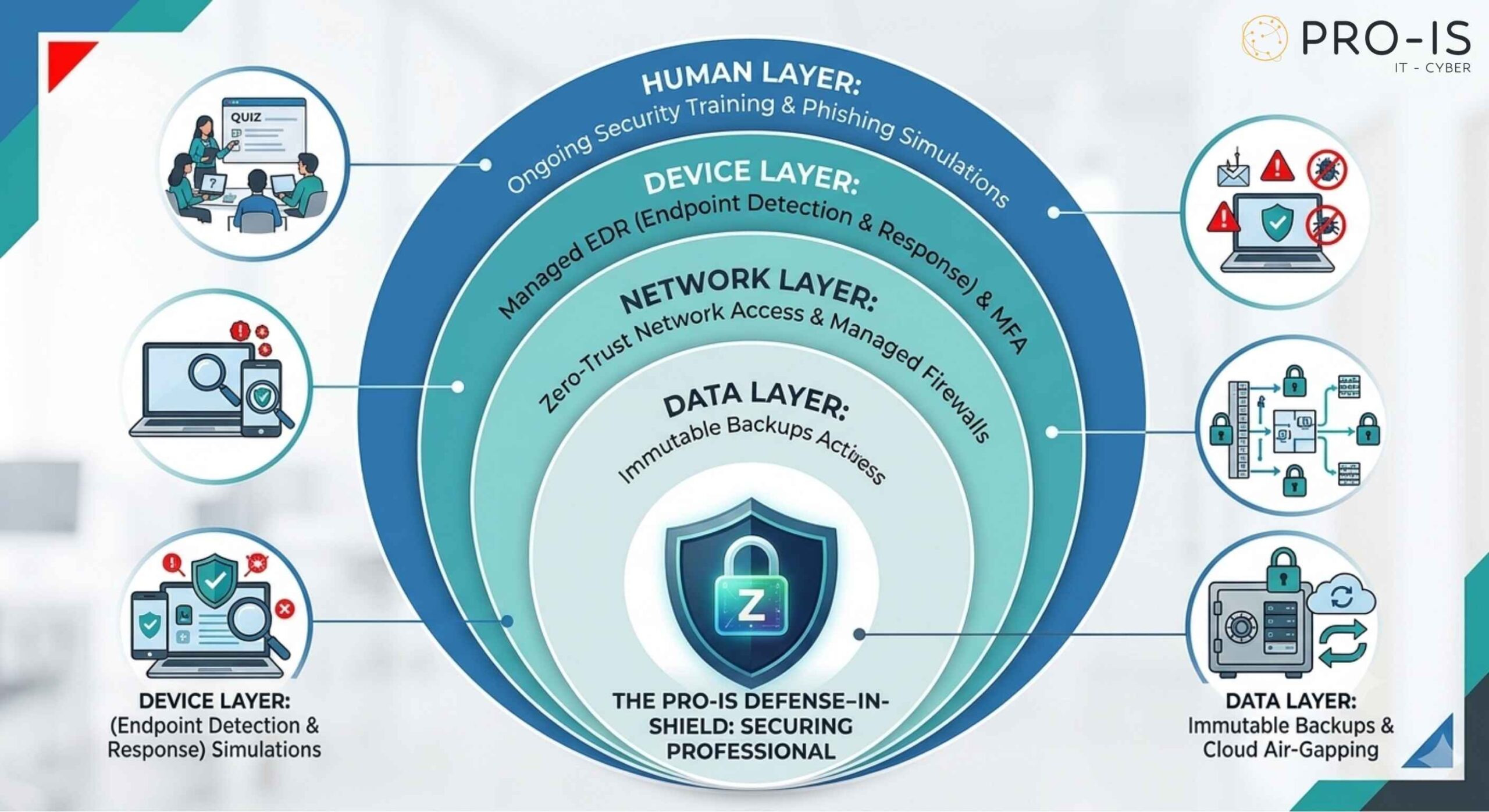
Our specialized security framework builds a multi-layered shield around your firm’s digital assets:
1. Zero-Trust Network Architecture

We implement a modern “Zero-Trust” framework across your entire IT environment. This methodology operates on a simple principle: never trust, always verify. By ensuring that every user, device, and application must be continuously authenticated before accessing sensitive client data, we drastically minimize your internal and external attack surface.

2. Proactive AI-Powered Threat Detection

We look beyond traditional, static antivirus programs. Our managed services feature 24/7/365 Security Operations Center (SOC) monitoring backed by advanced artificial intelligence. We actively hunt for anomalous behavior within your network, isolating potential threats before they can execute encryption or compromise your client communications.

3. Continuous Security Awareness Training

Because your employees are the primary targets for phishing and social engineering campaigns, we help you transform your staff into a resilient human firewall. We deploy automated, ongoing security awareness training coupled with realistic, simulated phishing campaigns to teach your team how to spot, flag, and report sophisticated digital scams before clicking a malicious link.

4. Comprehensive Compliance and Audit Alignment

We take the stress out of your annual cyber insurance renewals and regulatory audits. Our team handles the heavy technical lifting, providing you with the exact documentation, encryption validation, backup logs, and access controls required by insurance underwriters and federal compliance inspectors.

Secure Your Firm’s Future and Protect Your Client Privilege

Your clients choose your firm because they trust your expertise, your integrity, and your discretion. A single unmanaged cyber attack or data breach can obliterate that hard-earned reputation in a matter of hours, leading to lost billable hours, severe financial penalties, and a devastating breach of trust.

Your technology should be a strategic asset that fuels your firm’s growth, efficiency, and security—not an operational vulnerability that keeps you up at night.

Whether you manage an independent law firm in Boulder, a growing accounting practice in Fort Collins, or a real estate group in Loveland, Denver, or Greeley, the local team at Pro-IS is ready to help you implement a secure, compliant, and highly efficient IT roadmap.

Take control of your data protection, ensure your next cyber insurance renewal is seamless, and gain true peace of mind. Contact the proactive team at Pro-IS today at (970) 613-0980 to schedule your comprehensive, no-obligation technology and security consultation.

hacker breaking into a network

Safeguarding Your Business Against Cyberattacks: The Crucial Role of Hiring an IT Company

Introduction

In today’s interconnected digital landscape, small to medium-sized businesses (SMBs) face a constant barrage of cyber threats. The devastating consequences of cyberattacks, such as data breaches, financial losses, and reputational damage, can cripple even the most promising ventures. This is why it is essential for SMBs in Fort Collins, Denver, Boulder, Loveland, Longmont, and throughout Northern Colorado to prioritize cybersecurity. In this article, we will explore the significance of hiring an IT company for cybersecurity and how it can safeguard your business against evolving cyber threats.


Cybersecurity Challenges Faced by SMBs

Small and medium-sized businesses often underestimate the scale and complexity of cyber threats. They might believe that cybercriminals only target larger enterprises. However, studies have shown that SMBs are increasingly becoming prime targets for cyberattacks. These attacks can manifest in various forms, including

a) Phishing and Social Engineering Cybercriminals exploit human vulnerabilities to gain unauthorized access to sensitive data or networks by tricking employees into divulging confidential information.

b) Ransomware Malicious software encrypts critical business data and demands a ransom for its release, disrupting operations and causing financial losses.

c) Data Breaches Unauthorized access to customer or employee data, leading to legal consequences, loss of trust, and financial liabilities.

d) Malware and Viruses Infections that can compromise network integrity, steal sensitive data, or disrupt business operations.

cybersecurity

Expertise and Experience in Cybersecurity

By partnering with a reputable IT company, SMBs gain access to a team of cybersecurity experts who possess the knowledge and experience to defend against a wide range of cyber threats. These professionals stay abreast of the latest attack vectors, security vulnerabilities, and industry best practices to ensure your business remains protected.


Customized Security Solutions

IT service providers understand that each business has unique security requirements. They conduct comprehensive assessments to identify vulnerabilities and design tailored cybersecurity solutions to address your specific needs. These solutions may include:

a) Network Security Implementing firewalls, intrusion detection systems, and virtual private networks (VPNs) to safeguard your network from unauthorized access and data breaches.

b) Endpoint Security Deploying antivirus software, anti-malware solutions, and encryption tools to secure devices such as laptops, desktops, and mobile devices.

c) Email Security Implementing advanced filters, spam detection, and encryption protocols to minimize the risk of phishing attacks and email-based threats.

d) Data Backup and Recovery Establishing automated backup systems and disaster recovery plan to ensure business continuity in the event of a cyber incident.


Proactive Threat Monitoring

One of the most significant advantages of hiring an IT company for cybersecurity is continuous threat monitoring. Cybersecurity professionals utilize cutting-edge tools and technologies to detect, analyze, and respond to potential threats in real time. They employ advanced techniques, such as intrusion detection systems, log analysis, and behavior analytics, to identify suspicious activities and mitigate risks before they escalate.


Compliance with Regulations

For businesses that handle sensitive customer information or operate within regulated industries, compliance with data protection laws is paramount. An IT company well-versed in cybersecurity can guide you through the complex landscape of regulations such as the General Data Protection Regulation (GDPR), California Consumer Privacy Act (CCPA), and Health Insurance Portability and Accountability Act (HIPAA). They can assist with implementing necessary security controls and ensuring your business remains compliant, thus avoiding potential legal ramifications.

it services company

Cost-Effectiveness of Using a Cybersecurity Company

While some SMBs may hesitate to allocate a portion of their budget to cybersecurity services, the potential cost of a cyber incident far outweighs the investment in preventive measures. A single data breach can result in significant financial losses, legal penalties, and reputational damage. By hiring an IT company for cybersecurity, SMBs can take a proactive approach to protect their valuable assets, mitigate risks, and minimize the potential financial impact of a cyberattack.

Moreover, outsourcing cybersecurity services to an IT company can be a cost-effective solution for SMBs. Building an in-house cybersecurity team requires substantial investments in hiring, training, and retaining skilled professionals, as well as acquiring the necessary tools and technologies. On the other hand, partnering with an IT service provider allows businesses to access a team of experts at a fraction of the cost while benefiting from their collective knowledge and experience.


Enhanced Focus on Core Business Operations

Attempting to handle cybersecurity in-house can divert valuable time and resources away from your core business activities. SMBs often lack the necessary expertise and struggle to keep up with the rapidly evolving cybersecurity landscape. By entrusting your cybersecurity needs to a specialized IT company, you can free up your internal resources to focus on strategic initiatives and revenue-generating tasks, while leaving the complex task of safeguarding your business in the hands of experts.

access denied due to cyberattack

Proactive Risk Mitigation and Incident Response

Cybersecurity is not a one-time implementation; it requires ongoing monitoring, assessment, and proactive risk mitigation. IT service providers offer proactive support and incident response capabilities, ensuring that your business remains prepared for potential cyber threats. They conduct regular vulnerability assessments, penetration testing, and security audits to identify weaknesses and implement necessary security enhancements. In the unfortunate event of a cyber incident, they will have a well-defined incident response plan in place to minimize damage, restore systems, and prevent future breaches.


Peace of Mind and Business Continuity

By hiring an IT company for cybersecurity, SMBs gain peace of mind knowing that their critical business assets are protected. This peace of mind extends to customers, employees, and partners, who entrust their sensitive information to your care. A robust cybersecurity posture enhances your reputation as a reliable and trustworthy business, leading to increased customer loyalty and business opportunities.


Additionally, partnering with an IT service provider ensures business continuity. In the face of cyber threats, they can quickly respond, recover lost data, and restore operations to minimize downtime. This level of preparedness and resilience is crucial for maintaining productivity and meeting customer expectations, even during challenging times.


Conclusion


In today’s digital landscape, the importance of cybersecurity for small to medium-sized businesses cannot be overstated. By partnering with an IT company for cybersecurity, SMBs in Fort Collins, Denver, Boulder, Loveland, Longmont, and Northern Colorado can effectively safeguard their businesses against evolving cyber threats. With the expertise, experience, and tailored solutions provided by IT service providers, businesses can proactively mitigate risks, comply with regulations, and ensure the continuity of their operations. Investing in cybersecurity is not only a smart business decision but also a critical step toward protecting your assets, maintaining customer trust, and securing the future of your business in the digital age.

woman needing it support in fort collins

A Brief History of Cybersecurity & why is it so Vitally Important for Business Owners

As the world becomes increasingly digitized, the importance of cybersecurity is rapidly growing. With the rise of the internet and the ubiquitous use of technology, cyber threats have become more prevalent and sophisticated. It is essential for businesses, particularly small to medium-sized enterprises, to be aware of the history of cybersecurity and the importance of protecting their digital assets.


The history of cybersecurity dates back to the early days of computing. The first computer viruses emerged in the 1970s, with the infamous Morris worm infecting thousands of computers in 1988. In the 1990s, cybercrime became more organized and sophisticated, with the advent of hacking groups and cyber espionage. The 2000s saw the rise of ransomware and distributed denial of service (DDoS) attacks, which have become even more prevalent today.

it support specialist in fort collins

Small to medium-sized businesses are particularly vulnerable to cyber-attacks. These businesses often lack the resources to implement robust cybersecurity measures and are therefore more likely to fall victim to attacks. According to a 2020 report by Verizon, 28% of data breaches involved small businesses. Cyber attacks can have devastating consequences for these businesses, including financial losses, reputational damage, and even legal liabilities.


There are several reasons why small to medium-sized businesses should prioritize cybersecurity. Firstly, many small businesses have valuable digital assets, such as customer data and intellectual property. These assets can be compromised in a cyber attack, leading to significant financial losses and reputational damage. Secondly, small businesses are often part of supply chains, and a breach of their systems can have ripple effects on their partners and customers. Finally, complying with cybersecurity regulations is becoming increasingly important, particularly for businesses that handle sensitive customer data. Failing to comply with these regulations can result in legal liabilities and financial penalties.


Fortunately, there are several steps that small to medium-sized businesses can take to protect themselves against cyber threats. Firstly, businesses should implement robust security measures, such as firewalls, antivirus software, and intrusion detection systems. They should also ensure that their systems are regularly updated with the latest security patches. Secondly, businesses should educate their employees about cybersecurity best practices, such as using strong passwords and being vigilant against phishing emails. Thirdly, businesses should conduct regular vulnerability assessments and penetration testing to identify and address weaknesses in their systems. Finally, businesses should have a response plan in place in the event of a cyber attack, including procedures for reporting the attack, containing the damage, and restoring systems.

cybersecurity

At our Internet Technology company, we understand the importance of cybersecurity for small to medium-sized businesses. We offer a range of cybersecurity services designed to protect our clients’ digital assets and mitigate cyber threats. Our services include:


  • Security assessments: We conduct comprehensive security assessments to identify vulnerabilities in our clients’ systems and recommend strategies for mitigating these risks.
  • Managed security services: We provide ongoing monitoring and management of our client’s security systems, ensuring that they are always up-to-date and effective.
  • Incident response: We have a team of experienced professionals who are available to respond to cyber incidents, including data breaches and DDoS attacks.
  • Training and awareness: We offer training and awareness programs to help our client’s employees understand the importance of cybersecurity and how to protect themselves and their business from cyber threats.

We understand that cybersecurity is not a one-size-fits-all solution. That’s why we work closely with our clients to develop customized cybersecurity strategies that meet their unique needs and budget. Our team of experts has years of experience in the cybersecurity industry and stays up-to-date with the latest threats and trends, ensuring that our clients are always protected against the most sophisticated cyber-attacks.

Pro-IS IT support team of Fort Collins Co

In conclusion, cybersecurity is essential for small to medium-sized businesses. The history of cybersecurity has shown us that cyber threats are becoming more prevalent and sophisticated, and businesses that fail to protect their digital assets are at risk of significant financial losses, reputational damage, and legal liabilities. It is critical for businesses to prioritize cybersecurity and implement robust security measures to protect their digital assets.

At our Internet Technology company, we are committed to helping small to medium-sized businesses in Fort Collins, Denver, and Boulder, Colorado, protect themselves against cyber threats. We believe that every business deserves the peace of mind that comes with knowing their digital assets are secure. Contact us today to learn more about how we can help your business stay protected against cyber threats.

If you need an IT Managed Support Provider or help with Cybersecurity

If you’re in Fort Collins, Loveland, Greeley, Denver, Boulder, or the surrounding area and don’t have an IT Service Provider or are looking for managed IT support, cyber security, IT services, or IT coverage, contact Pro-IS for a free consultation (970) 613-0980.

it-support-boulder

Cyber Security: 3 Common Strategies Used by Scammers & How to Protect Yourself from Cybercrime

cyber security logo for pro is

Cyber Security: 3 Common Strategies Used by Scammers and How to Protect Yourself from Cybercrime

With cybercrime on the rise, keeping your personal information safe online by watching out for cybercrimes is now important than ever. As Fort Collins, Boulder, Denver, and Northern Colorado residents, we are well aware that scammers are constantly coming up with ways to hack into people’s phones, personal computers, tablets and internet accounts to get access to their personal information and money. It is therefore necessary to familiarize yourself with the strategies used by these fraudsters to so that you can protect yourself.

man reviewing internet security in boulder colorado

Here are some of the common tactics used by scammers to gain access to people’s personal information and money, and how you can protect yourself from cybercrime:

1. Phishing Scams

When scammers create fake emails or web pages that appear to be from a legitimate organization or person, it is referred to as a phishing scam. Usually, you will be asked to provide your bank account details, password, credit card number or Social Security number via that email or web page. Scammers can also contact you by phone or text message pretending to be from a genuine business like a telephone, bank or internet service provider and ask you for your personal information.

For instance, the scammer can tell you that the bank or company needs to verify customer records because of a technical error that erased customer data. Phishing messages are written in such a way that they look authentic, and usually copy the format used by the company the scammer is pretending to be from, including their logo and branding. The rule of thumb is to never give your personal information to anyone over the phone or online if you are not one hundred percent certain who they are.

If the email or phone call seems suspicious or looks off, it most likely is. And, if you make the mistake of giving the scammer your personal details, the details will be used to carry out fraudulent activities, like using your credit cards and stealing your money. So, avoid giving your personal information over the phone or online, unless you are absolutely sure who you are dealing with. 


2. Ransomware

Another tactic used by cybercriminals that you need to watch out for is ransomware. Ransomware is malware that cybercriminals use to freeze phones, tablets and computers in order to steal important data, demanding a ransom. Ransomware prevents you from using those gadgets or accessing particular files until you have paid the ransom. It usually encrypts your files so that you cannot open them. Examples of ransomware include CryptoLocker, CryptoWall, Reveton and Locky.

Because ransomware is distributed as malware disguised as a file that is legitimate, you may assume that it is a legitimate file and install it on your device. However, when installed, it can lock your device and display a “lock screen” with a message stating that if you want to have access to your computer, pay a ransom. You can avoid ransomware by ensuring that you do not click on links or attachments from email addresses you don’t know, and do not download or open files from untrusted websites. Also, make sure that you keep your software up to date on all your gadgets, in particular antivirus or internet security software.

cyber it services man

3. Charity Scams

You should also watch out for fake charities whose aim is to take advantage of your compassion and generosity for others in need. Although supporting charity organizations is a great thing to do, it is important to make sure that you do not become a victim of scammers. These fraudsters impersonate genuine charities and contact you, asking you for donations, usually after major events or a natural disaster. They can set up donation pages or send you fraudulent emails just to steal your money.

Before you donate money to charity, make sure that you do your research first. Avoid new organizations established for a particular crisis. Instead, go for those trusted organizations that have been around for some time. And watch out for charity organizations whose names are very similar to popular charities. Also, be on the lookout for phony social media accounts, emails, phone calls and crowdfunding requests, including email attachments from contacts that are familiar. Do not rush to donate your hard-earned money without properly evaluating the charity organization first.

The Bottom Line on Cyber Security

Cybercrimes are real, and some people have been victims of cybercriminals. The first thing you need to do to protect yourself from cybercrime is to familiarize yourself with the tactics used by cybercriminals to gain access to your personal details and ultimately steal your hard-earned money. Then, take the necessary steps to avoid being a victim of cybercrime.

If you’re in Fort Collins, Loveland, Greeley, Denver, Boulder, or surrounding area and don’t have an IT Service Provider or are looking for managed IT support, cyber security, IT services, or IT coverage, contact Pro-IS for a free consultation (970) 613-0980.